Not All Certificates Are Created Equal: What Makes NNHH Certificate Programs Different?
May 29, 2026In dental professional development, the word certificate is often used broadly, yet its meaning varies significantly. A dental professional may receive a certificate of attendance or participation for a lecture or a single-course dental CE activity. However, an ANSI-accredited certificate program represents a rigorous, assessed curriculum. Understanding this distinction is essential for clinicians navigating their roadmap for post-license education and credentialing.
The Distinction Between Certificate Programs and Continuing Education (CE)
At NNHH, we prioritize credentialing clarity. An ASTM E2659 accredited certificate program is fundamentally different from traditional dental CE. The development of these programs follows a rigorous, systematic design process that includes a needs or gap analysis, precise learning outcome alignment, and curriculum mapping, distinguishing them from informal training. While CE documents participation in learning activities, NNHH certificate programs represent a bridge between standard CE and a degree. They support workforce development and the integration of registered dental hygienists into medical settings through an assessed certificate of completion.
Dental CE pathways such as AGD PACE, ADA CERP, and AADH are important within dentistry. AGD PACE recognizes different educational methods, including lecture, clinical participation, and self-instruction (1, 2). ADA CERP evaluates continuing dental education providers and states that it approves organizations that provide continuing dental education, not individual educational activities (3). ADA CERP also states that the Commission for Continuing Education Provider Recognition (CCEPR) does not approve lecturers, individual courses, or credit hours (4). AADH provides a pathway for continuing education provider approval for dental professionals (5).
NNHH certificate programs go beyond documenting attendance. They are structured educational offerings with defined learning outcomes built on published global certificate program accreditation standards. Upon successful completion of all requirements—including a 18-34 hour curriculum, a verified capstone project, and a summative assessment—learners are awarded CE credit, a certificate of completion, a digital badge, a digital wallet and an educational credential (e.g., CH-OSE, CH-ONC).
All NNHH programs are developed according to ASTM E2659 standards. Once a program has sufficient data to validate its outcomes, it is submitted for formal ANAB accreditation. Graduates of these certificate programs receive a verifiable certificate of completion that signals their advanced preparation for interdisciplinary healthcare roles. Once a program achieves accreditation, all existing and future certificate holders receive a certificate and digital badge with the approved accreditation logo.
A key difference is implementation. NNHH programs include a Capstone Project requirement that helps learners apply what they learned in a meaningful, practice-based way. Learners find NNHH capstone projects to be profoundly rewarding, self-confirming, and a vital bridge between theory and real-world practice. They frequently share that the experience gives them the confidence to step outside their traditional roles and make a tangible impact.
NNHH also supports modern, verifiable recognition through digital badges, which help learners share completed training, skills, and program details with employers, healthcare partners, and professional networks; NNHH explains more in Why Digital Badges Are the Future of Dental Hygiene Credentials.
Simple Comparison
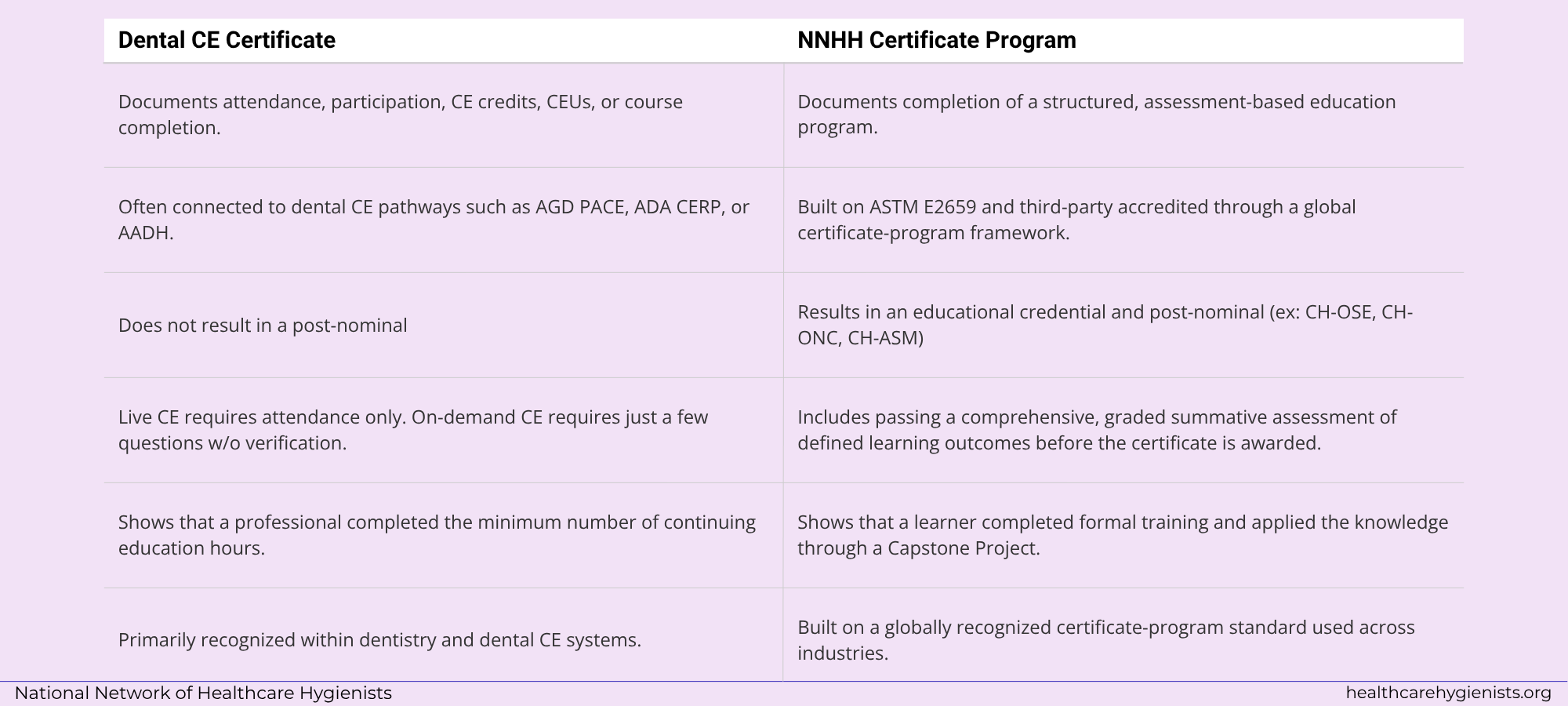
Both types of education have value. Dental CE helps professionals stay current, meet CE requirements, and continue learning throughout their careers. If a learner’s goal is to remain primarily within traditional dentistry, dental CE may be enough because its purpose is often to support professional development and maintain a dental license.
If a learner wants to expand into broader healthcare settings, however, a more rigorous training pathway may be better suited. That may include a university-based certificate program or a third-party ANSI/ASTM E2659 accredited certificate program from a well-respected nonprofit organization like NNHH. These programs are designed to support deeper preparation, assessed learning outcomes, workforce development, and healthcare integration. ANAB-accredited training programs under the ASTM E2659 standard are superior because they enforce rigorous third-party oversight, validate that the curriculum achieves measurable learning outcomes aligned across the program deliverables, and ensure programs are continually internally and externally evaluated. This strict standardization offers major benefits for both learners and employers.
For learners exploring payment options, NNHH also explains how eligible ANAB-accredited certificate program expenses may be supported through 529 plans or Coverdell ESAs in A New, Flexible Way to Fund Your Oral Systemic Educator Certificate.
NNHH certificate programs are created to build formal pathways that help RDHs demonstrate advanced preparation for healthcare integration, interdisciplinary collaboration, and expanded workforce roles.
The goal is clarity in professional status. A dental CE certificate says, “I participated in education.” An NNHH certificate of completion from an accredited program says, “I achieved the intended learning outcomes of a structured workforce-development program.”
- New to NNHH? Start with the IPE Competency Training for RDHs (required for all certificate programs)
REFERENCES